

A walking safari is the slowest way to see northern Tanzania, and for many travellers it is the most absorbing. On foot, with a guide, the landscape stops being a backdrop seen through a window and becomes a set of small clues: a flattened patch of grass, a line of ants crossing a path, a francolin calling sharply from a thicket. This guide explains in general terms what a guided walking safari around Tarangire National Park and its surrounding conservation areas involves, what you can reasonably expect to learn, and how to prepare.
Tarangire sits south of Lake Manyara in the Manyara Region, about two to three hours by road from Arusha, and it is one of the most distinctive parks on the northern safari circuit. It is known for its huge baobab trees, its grassy ridges, and the Tarangire River, which draws animals in from a wide area when the dry months arrive. Walking is not offered everywhere in the park, so it helps to understand where and why it is done before you plan.
Why walk instead of drive
A game drive covers ground and gives you the best chance of finding large animals quickly. A walking safari does something different. It slows everything down so that you notice the details that a vehicle passes at speed: the texture of a termite mound, the smell of wild sage crushed underfoot, the sound of insects and the way the light changes as the sun climbs. Most people who walk say that they come away understanding the bush better, even if they have seen fewer animals in total.
The pace is gentle, usually a few kilometres over two to three hours with frequent stops. The guide will stop often to explain what you are looking at. Walking suits travellers who are curious about ecology, tracking, birds, insects and trees, and it suits anyone who has already done a few game drives and wants another layer of experience. It is a complement to a classic safari rather than a replacement for it.
Where walking is possible around Tarangire
Walking inside Tarangire National Park itself is tightly controlled. National parks in Tanzania are managed by Tanzania National Parks, and in many of them, including large parts of Tarangire, visitors are expected to stay in their vehicles outside designated picnic sites and short, supervised walks. This is a safety measure and also a way to keep disturbance to wildlife low. If a walking safari matters to you, the practical route is usually to look at the conservation areas, wildlife management areas and private concessions that surround the park.
These neighbouring areas are part of the wider Tarangire ecosystem, which is far larger than the national park. Wildlife moves across it through the year, and community-managed land in areas such as the Burunge and Randilen wildlife management areas lies on its edges. Walking rules differ by area, so the right question to ask when planning is simply which areas permit guided walks on foot, with which guides, and under what conditions. Your operator should be able to answer this clearly before you book.
It is also worth knowing that walking is not done in some places at all. Dense bush with poor visibility, areas with very high concentrations of buffalo or elephant, and places close to a river with hippo and crocodile can all be judged too risky. A responsible guide will decline a route that does not feel safe, and you should treat that as good judgement rather than disappointment.
An early start and a slow rhythm
Walks usually begin shortly after sunrise, sometimes slightly earlier, because the first hours of the day are cool and animals are more active. By late morning the heat builds, the light flattens and many animals settle into shade. A typical outing starts with tea or coffee at the camp or lodge, a short drive to the starting point, and a briefing before the first step.
Expect to walk in single file behind the lead guide, with a second armed ranger at the back in many cases. The pace is set to the slowest member of the group. You are asked to be quiet, to avoid sudden movements and to stay together. Conversation is kept low, because a walking group that talks loudly will see very little. Many people find that after the first twenty minutes the mind quiets, and they begin to hear the bush properly.
Wind, scent and approach
The first thing a good guide checks is the wind. Almost every animal in the bush has a far better sense of smell than we do, and a walking group that approaches from upwind is announced long before it is seen. For that reason the guide will often adjust the route to stay downwind of the animal you want to observe, sometimes taking a longer curve to do so.
You will also notice that guides watch the behaviour of animals at a distance and read it as a signal. A giraffe that lifts its head and stares in one direction, a herd of zebra that bunches and turns, or an impala that snorts and stamps all tell the guide that something has been noticed. The aim is never to push closer for a photograph. It is to stop at a respectful distance, watch calmly, and leave without altering what the animal was doing.
Reading footprints and tracks
Tracking is the heart of a walking safari. A footprint tells you the species, roughly the size and sex of the animal, the direction it was travelling and how recently it passed. Soft sand along a dry riverbed holds prints beautifully, which is one reason the sand rivers of the Tarangire region are such good places to learn.
Elephant tracks are broad and rounded, with a soft cracked pattern of the sole visible in good light. Giraffe leave a large, long cloven print that looks like a split hoof. Zebra leave a single solid hoof print, since they are equids, while buffalo leave a broad cloven print with rounded toes. Lion and leopard prints show four toes and a pad without claw marks, because cats walk with their claws retracted. Hyena and jackal prints show visible claw marks, which is one simple way to separate dog family tracks from cat family tracks.
Age is judged from the edges. A crisp print with sharp edges and little debris in it is fresh. A print softened by wind, with fallen leaves or a trail of insects across it, is older. After rain, the whole picture changes, because water erases detail quickly. A guide will often kneel, hold a hand over a print and tell you more than you would believe possible from a patch of dust.
Dung, scratches and other signs
Dung is another clear text for those who learn to read it. Elephant dung is large and fibrous, and a guide may break it open to show how recently it was dropped and what the animal has been eating. Giraffe leave small pellets scattered widely, and zebra leave rounder droppings full of grass fibre. Hyena droppings are pale and chalky because of the bone they eat, and a hyena latrine near a path is a useful sign of territory.
There are other signs too. Rubbed bark on a tree trunk shows where elephants or buffalo have scratched, and mud on the trunk marks the height of a wallow visit. Torn branches at the top of acacia trees point to giraffe, while stripped bark can indicate elephants. Dust baths, burrows, termite mounds opened by an aardvark or honey badger, and the pale spiral of a snail shell on the ground all offer small stories. You learn to see that the bush is busy even when no large animals are visible.
Birds and alarm calls
Birds are the bush's early warning system, and a good guide listens to them constantly. A sudden change in the call of a francolin, hornbill or lilac-breasted roller can mean that a predator is near. Vervet monkeys and baboons give distinct alarm calls for leopard, snake and eagle, and a trained ear can tell which.
Tarangire has an excellent bird list, often given at over five hundred species across the wider ecosystem. Among the birds you may encounter are ostrich, yellow-collared lovebirds, ashy starlings, hornbills, bee-eaters, secretary birds, kori bustards and many raptors. The Tarangire River and the swamps attract waterbirds in the rains. On foot, with binoculars and a patient guide, birdwatching is one of the most rewarding parts of the day.
Baobabs, rivers and the landscape
The baobab is the park's signature tree. These enormous trunks can store large quantities of water and live for centuries, and they are a keystone for many species. Elephants strip the bark for moisture, birds nest in the hollows and bats roost in the larger trees. Standing beneath one on foot, you appreciate the scale in a way a vehicle window never quite delivers.
The Tarangire River is the heart of the ecosystem. In the dry season it shrinks to a series of pools and a thin channel, and its sand banks and permanent water pull in animals from far away. Side channels and seasonal sand rivers cut across the landscape. Walking along them is a classic way to look for tracks, because the sand preserves them cleanly and the open ground makes it easier to see what is coming.
What you can see on foot
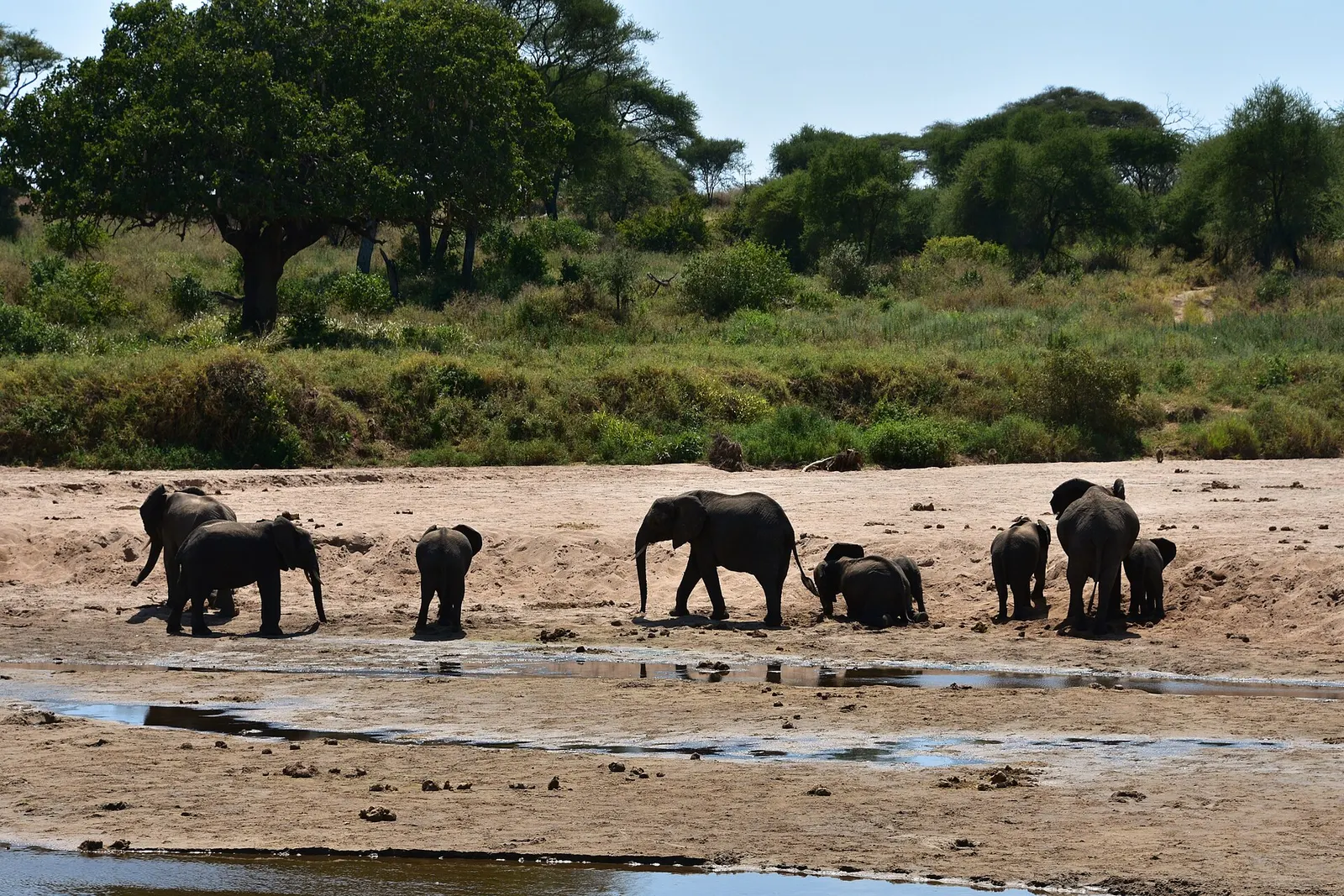
On foot you will often see impala, giraffe, zebra, warthog, dik-dik, baboons and a variety of birds, and you may see elephant, wildebeest, eland, waterbuck and buffalo at a respectful distance. Elephants are a feature of the Tarangire ecosystem, and during the dry season large family herds gather near the river. Lion and leopard live in the area, but they are secretive and well camouflaged, and sightings on foot are less common than from a vehicle. They should never be expected.
What you are more likely to notice are the small things. Dung beetles rolling their prize, the spoor of a night visitor across the path, a chameleon in a bush or a column of safari ants moving across a track. Many travellers say that it is these moments, not the big animals, that they remember most. If your expectations are set to learning rather than ticking off a list, a walk will be a very satisfying outing.
Safety briefings and the role of the guide
Every walk begins with a safety briefing. You can expect to be told to stay in line, to keep behind the guide, to move slowly, to never run, and to follow instructions immediately if the guide gives a signal. If an animal is too close, the guide may ask the group to stop, crouch or step back quietly. Running is discouraged because it can trigger a chase response in predators and in some other animals.
Walks are typically led by a qualified guide, often accompanied by an armed ranger. The ranger is there as a last precaution, and a well-run walk is built on avoiding trouble in the first place, through reading signs, watching the wind and keeping a safe distance. Guides in Tanzania are licensed, and park authorities set requirements for the activities permitted in each area. It is reasonable for you to ask your operator what the arrangements are before booking.
Children are usually not permitted on walking safaris, and minimum ages differ between areas. Travellers with mobility concerns, heart or respiratory conditions, or pregnancy should discuss it with their doctor and the operator before deciding.
What to wear and carry
Wear neutral colours such as khaki, olive, tan and soft green. Bright white, black and blue are best avoided, since dark blue and black can attract tsetse flies and bright colours stand out in the bush. Long trousers and a long-sleeved shirt protect against sun, thorns and insects. Comfortable, broken-in walking boots with ankle support and thick socks are the most important item you will bring. New boots on a long walk are a poor idea.
Carry a hat, sunglasses, sunscreen, binoculars, a small daypack, insect repellent and a refillable water bottle. A light jacket is useful because early mornings can be cool, especially in the dry months. A buff or scarf is handy against dust. A camera with a modest zoom lens is enough for most outings, and a small notebook is handy for the details you will want to remember afterwards.
Fitness, health and safety
You do not need to be an athlete. A walk is generally easy to moderate on flat or gently rolling ground, but you should be comfortable being on your feet for two to three hours in warm conditions. The heat and the sun are more tiring than the distance. Drink water regularly and use sun protection even when the morning feels cool.
Malaria is present in northern Tanzania, so talk to a travel health clinic well before departure about prophylaxis, vaccinations and insect protection. Tsetse flies occur in some bush areas and their bites can be painful. Keep travel insurance in place, including medical evacuation cover. Tell your guide of any allergies or medication in advance. Staying alert, drinking enough water and walking at the guide's pace remain the best precautions.
Best time of year
The dry season, usually from late June to October, is widely regarded as the best time to visit Tarangire for wildlife. As the grass dries up and water elsewhere disappears, animals concentrate along the river, and large numbers of elephant, wildebeest, zebra, buffalo and giraffe can gather. The ground is firm, walking is comfortable and visibility is good.
The green season, from November to May, brings rain and a very different atmosphere. Wildlife disperses across a wider area, the park turns green, migratory birds arrive and the landscape is beautiful, but walking can be muddier and wildlife is harder to find. The long rains in April and May are usually the quietest period. January and February are often a drier interlude and can be rewarding for birds. If walking is your priority, the dry months are the safest choice, though a good guide can make any season interesting.
How walking differs from a game drive
On a game drive you are in a vehicle that acts as a hide: animals generally tolerate it and you can approach more closely. On foot you are a human figure, and animals respond more cautiously, so you tend to watch from a greater distance. Drives cover long distances in a day, and walks cover only a few kilometres, but with far more attention to detail.
Most travellers combine both. A morning walk followed by an afternoon game drive gives a good balance, and a walk can add real depth to a few days of driving. Walks are not a way to see more of the big five, and it is better to approach them as a different kind of safari altogether.
Ethics and park regulations
Responsible walking follows a few simple rules. Keep your voice low, stay with the group, do not leave the path or approach animals, never feed wildlife and carry out everything you carry in. Do not pick up bones, plants or stones as souvenirs. Drones are generally restricted in Tanzanian parks and should not be used without permission.
Park fees and regulations are set by the managing authorities and change from time to time, so it is best to check current requirements through your operator rather than rely on a printed figure. Choosing operators who employ and support local communities, and who respect group size and wildlife limits, helps keep walking safaris sustainable.
Planning your trip
Tarangire fits easily into a northern circuit with Lake Manyara, the Ngorongoro Crater and the Serengeti, and two nights is a sensible minimum to experience it properly, with a walk as part of the stay. If you would like to explore a walking safari around Tarangire, whether on its own or as part of a longer journey, you are welcome to contact The Expedition Tours. We can talk through the season, the areas where walking is permitted and the style of trip that suits you, and plan it with you from there.
About The Expedition Tours
The Expedition Tours plans safaris, Kilimanjaro climbs and Zanzibar extensions from Arusha, Tanzania, built around each traveller.
See our routes →More Field Dispatches
All field notes →
How Altitude Works on Kilimanjaro: Pacing the Lemosho Route
A plain-English guide to altitude on Kilimanjaro: acclimatisation, altitude sickness, pole pole, climate zones and how the Lemosho route helps you pace the climb.
Ndutu in February: What to Expect During the Calving Season
Every year, usually from late January to March, the wildebeest gather on the southern plains to calve. What to expect around Ndutu in February, and how to plan for it.